mrissa: (Default)
 

New story out today in Lightspeed: Until the Cure is about eldercare, exhaustion, and supporting each other through the worst of it. It's feeling appropriate in my extended family (thankfully not in my household) today, but then I think, well, when wouldn't it, that's kind of why I wrote it....

mrissa: (Default)
 

Can*Con is coming soon, and I will be there! If you'll be there too, find me in the following places (or just around the con)!

Worldbuilding Focus: Park Politics. Saturday, October 17, 4:00 p.m., Mainstream room (3rd floor). The deliberate construction of the natural environment into “parks” and “sites” is a complicated part of any country, with a number of key considerations as part of worldbuilding. What are the overt and implicit goals of a park? Who is involved in their construction - and who is deliberately left out or displaced? Is the power over a space in the hands of its indigenous population or someone else, and how can that be used as commentary on the hierarchies and power structures of your world? Our panelists discuss examples from across genres and how real-world history can be used to inform considerations of parks and rec in fiction.

Classic or Merely Old? Saturday, October 17, 7:00 p.m., Traders room (2nd floor). Some vintage SFFH, like Dune, Wizards of Earthsea, and Frankenstein, are considered classics of the Anglophone SFFH world, worth remembering and studying even now. Others have been forgotten, and more are still considered despite their flaws (e.g. the racism and xenophobia present in H.P. Lovecraft’s works). What are the influences that determine which works get remembered, and which do not? How do we engage with the global Anglophone foundations of genre, while also being mindful of social and cultural changes? And how do we navigate inclusions, deletions, and qualifications to those foundations?

Horned Lark Press Party. Sunday, October 18, 10:00 a.m., Leaders room (2nd floor). My understanding is that this will involve several things but include me reading a bit of A Dubious Clamor, although I'm open to other plans if my publisher makes them.

Book signing. Sunday, October 19, 11:00 a.m., Vendors room (Newbridge room, Horned Lark Press table).

mrissa: (Default)
 

Douglas Adams, The Hitchhiker's Guide to the Galaxy. Reread. I'm running a bit short on TBR pile at the same time as I'm looking forward to a "Classic or Just Old?" panel at Can*Con in mid-October, so several of the things I've read in this fortnight have been with that panel in mind. The interesting thing about this one is that basically all the good bits are perpetuated and reproduced in nerd culture. Usually there are at least a few "oh I forgot about that"s, especially in a book I haven't read since 1992 at the latest (probably more like 1990).

Louisa May Alcott, Under the Lilacs. Reread, Kindle. And speaking of books I haven't read in a minute: this was the Alcott I didn't own and the branch of the library I used most regularly also didn't own. So while it was a reread, I didn't retain nearly as much of it as I do of, um. Any of her other work. Which is too bad, because it has a poodle (although also the poodle has some official and substantial peril, which I wouldn't have liked much even knowing how it would end). It also has a gratuitous section anti-Chinese racism--no Chinese characters, but room for racism all the same. Sigh.

Stephanie Burgis, A Waltz of Sinister Import. Discussed elsewhere.

Octavia Butler, Patternmaster. Reread. Violent and straightforward telepath-on-telepath violent adventure with plenty of violence. Did I say violence? Yes. Did I say nuance? Not really; this is one of my nominees for "author wrote some classic work but not all her work is classic."

Pamela Dean, The Dubious Hills. Reread. I let myself reread this favorite in honor of my own dubious book. We are doing very different things with doubt in them, but hardly anybody else is taking it head-on at all, so I went to go sit by Pamela for a bit, literarily speaking. Still love this so much.

Fabio Fernandes and Djibril al-Ayad, eds., We See a Different Frontier. Kindle. It's always nice when one doesn't get to an anthology anywhere near its publication date to find that it has held up. Several people in here are now much more broadly published, which is good to have the hindsight to see, but I really enjoyed most of the stories, and "most" is about all an anthology usually gets.

John M. Ford, The Princes of the Air. Reread. Always with your games and identity, Mike. Well.

Orsola Casagrande and Mustafa Gündoğdu, eds., Kurdistan +100: Stories from a Future State. Read this for book club, and it's the sort of science fiction anthology you get when most of the authors don't regularly write science fiction: there was a lot that felt like attempting to invent the concept of science fiction from scratch and ending up with similar sorts of clunky telling that we got early on. In service to this very underrepresented culture, still interesting to have.

Jonathan Healey, The Blazing World: A New History of Revolutionary England. This was about most of the 17th century rather than just the years of the English Civil War and Cromwellian Interregnum, and I think that was to its benefit. If you're not very familiar with that placetime, this is a good place to start, and if you are, it's still well done and interesting.

Malavika Kannan, Unprecedented Times. An autofiction by/about someone whose first year at Stanford was the fall of 2019. So yes, a pandemic novel, staggeringly and overwhelmingly a pandemic novel. One of the things that's always a question with autofiction is whether it's the auto- or the fiction part that has failed when there is a failure: if the characters of the former friends seem flat and insufficiently considered, is it because she didn't do as good a job with that part of writing fiction as with some of the other elements of this novel? Or is it because she is accurately writing down real behavior she never fully understood? Both are possible--even, I suppose, simultaneously. It's a very young novel and I sometimes lost patience for the protagonist and/or for the author, but the writing propelled me through all the same.

Ursula K. Le Guin, Words Are My Matter. Kindle. This is a collection of minor Le Guin nonfiction: introductions to other people's books, short reviews, a few speeches and essays. It's nice. It's not more than nice, mostly.

Rose Macaulay, What Not. Reread, Kindle. This, on the other hand, is not nice at all, and I love it. It's darkly hilarious. It understands the science fiction technique of incluing when the official genre of science fiction mostly had no clue about it. It's a dystopia whose people are very directly the people she knew, generally speaking; they read like the cast of any other 1918 English novel, but gone horribly wrong with eugenics. I think one of the great things about What Not is that her dystopian technologies are entirely social. Macaulay understands that it's people, the problem is humanity, and the solution, to the extent that there is one, is also humanity.

Iain Pears, Stone's Fall. I hate this book so much that I hope I remember how much I hate it and never read anything by this author again. The twist ending is so unmotivated and so stupid and so bad. The problem is that he can write sentences, so I kept reading, and it got thoroughly and abruptly worse.

Sophia Smith Galer, How to Kill a Language: Power, Resistance, and the Race to Save Our Words. Smith Galer's focus is entirely away from the circumpolar region that's my particular interest here, but it's still a compelling collection of essays that focuses more on how to save languages when we can than on how to kill them. The resistance is not in the subtitle just for marketing clicks. Good read.

P.G. Wodehouse, My Man Jeeves. Kindle. This sure was itself. The non-Wooster-and-Jeeves stories were less good, but still fine. I knew what I was getting into.

Patricia C. Wrede, Dealing With Dragons and Searching for Dragons. Rereads. I didn't find these at a young age like a lot of the fantasy writers my age--I was in my twenties and living in this house and had read other books by one Patricia C. Wrede. But these are definitely high on the list of Pat's works considered classics, and they're fun, fast reads; glad to have gotten to them again.

mrissa: (Default)

As always, but possibly more so, I haven't gotten to everything, so please feel free to recommend more things in the comments!

Chorus for Solo Voice, Marie Brennan (Sunday Morning Transport)

A Game of Go, P.A. Cornell (Adventitious)

Sturgeon Baby, Sophie Fink (Reckoning)

Indigo, Heera Kumar (Strange Horizons)

Pieces of Anna, R.L. Meza (Haven Spec)

And So I Open My Fists, Rachel Sobel (Clarkesworld)

"Gramarye," Sonya Taaffe (Not One of Us)

Leavetaking, Tia Tashiro (Uncanny)

Can't Rain All the Time, Merc Fenn Wolfmoor (Gavagai)

If You Don't Return, I Want You To Know, Merc Fenn Wolfmoor (Haven Spec)

 
mrissa: (Default)
 

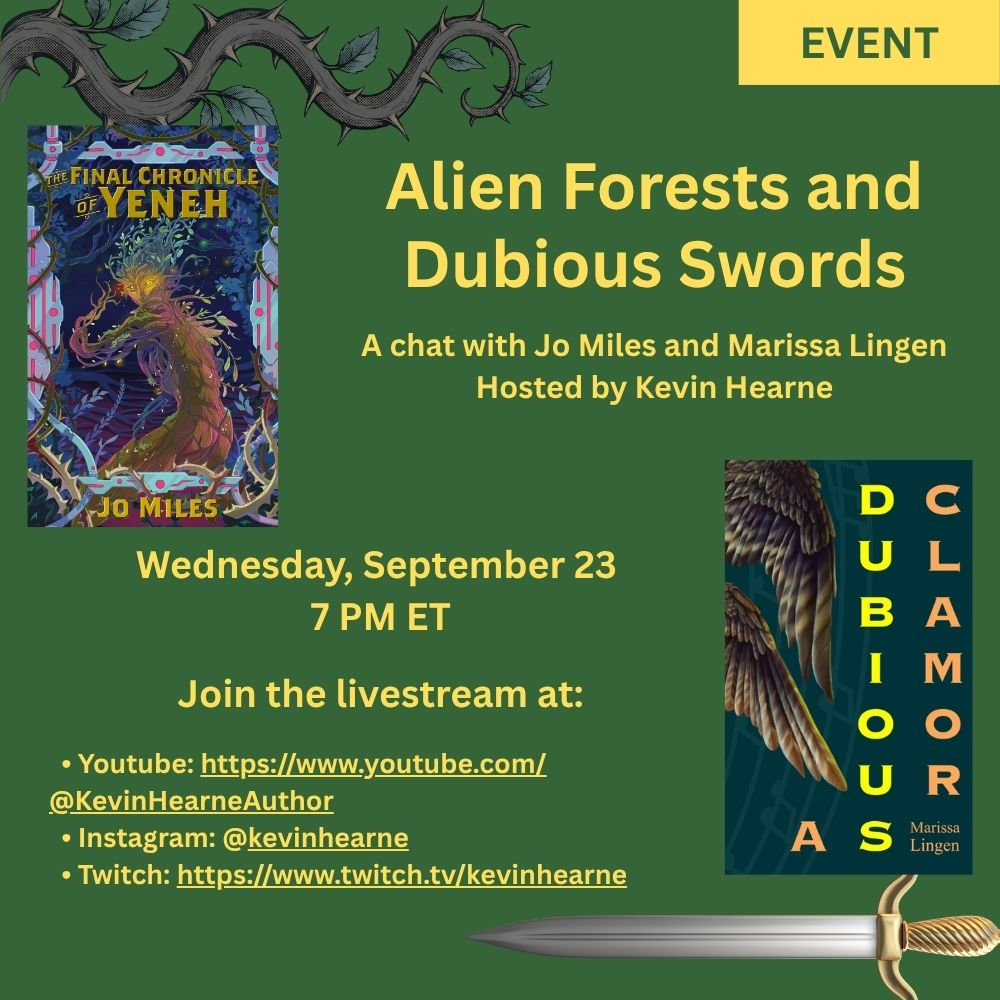
Come on out--in the privacy of your own home, with your own mug of tea and your own comfy clothes--to a virtual book event Wednesday! Friend and fellow Horned Lark Press author Jo Miles and I will be discussing our recent books, with our publisher Kevin Hearne as our host!

mrissa: (Default)
 

Review copy provided by the author, who is a dear friend.

I think I get to say "triumphant conclusion" again! I love to say "triumphant conclusion." If you're less fond of that phrase, okay, okay, this is the third book in the Lord and Lady Riven series, and I would not recommend starting here, because much of what makes the characters' actions work, much of the interest and impact, is contextual from previous stories. It's that it's not a sitcom plot where the characters reset every time, they're actually learning how to be with each other and with the rest of the world.

Which is a thing I really love about this series: it doesn't stop at "these people are in love," which is great because things don't stop there. Not only fantasy plot things, but relationship things. We will keep running into different magical creatures and artefacts, sure, because that's how this world is (and it's a lovely fantastical reflection of how this world is, rich and diverse), but also we will keep developing as people, and figuring out how to have our marriage reflect that. I particularly loved that being concerned with and attentive to the needs of vampires did not magically make Margaret fully aware of the needs of the new person she meets. It's an aspect of disability justice that I don't see often enough in fantasy metaphor, and it was wonderful here.

Also I have a few friends I'd have wanted to huddle under an invisibility cloak with for shenanigans shortly after meeting them. Yes, absolutely. Some people immediately strike you that way.

mrissa: (Default)
 

Kenzie Allen, Cloud Missives. This was a birthday present that came with a content warning, and rightly so: some of the topics of these poems are harrowing, and the language is vivid enough to highlight rather than blunt them. Which is a good thing. But proceed with caution.

Attar, The Conference of the Birds. A twelfth century allegorical poem, featuring a great many conversations between symbolic birds and quite a lot of focus on what it means to be a good person living a good life, many of the conclusions of which are absolutely opposite my own, but still of interest to see how another time and culture developed them.

Rachel Carney, Octopus Mind. Mostly poems about dyspraxia, mostly the sort of poems that very much come right out and say what they're about. There are some fairly high highs in this collection for me but also some fairly low lows.

Victoria Chang, Tree of Knowledge. Of the three poetry collections I read this fortnight, this was the one that was most "my thing," most vividly natural with a confident personal voice.

Agatha Christie, The Clocks. Kindle. The cats in this book did not rise to the level of Bob the dog but were still very reasonable cats, it was clear she had met cats and made observation of them. Anyway it was a reasonably cromulent Christie mystery if you want one of those.

Deva Fagan, The Delta Codex. A middle grade science fiction novel with a young heroine trying to make sense of her own memories and milieu on a hostile planet whose hostility is at least in part its humans. I really liked this.

Dorothy Canfield Fisher, The Home-Maker. Kindle. This is a fascinating novel from the mid-1920s, the premise of which is: what if people who are unhappy with their currently assigned gender roles got to swap and were much better suited for the opposite gender roles? And it's very interesting to watch her construct that for her time, but I found the ending very unsatisfying (horrifying actually). Also, and crucially, I know someone who treated her family exactly like the mother in this book treated her family at the beginning...and had a major career the whole time. So I had a very hard time thinking that "just get her a job she finds engaging!" was going to be enough.

Dana Frank, The Long Honduran Night: Resistance, Terror, and the United States in the Aftermath of the Coup. Kindle. This was a personal account of the author's involvement with activism on behalf of Honduran civil liberties, in the US and Honduras. She was very clear about it being her perspective, her experiences, not a universal account with any linguistic pretense of objectivity. I still--therefore? still?--learned a lot from it. It was about as much fun as you'd expect, but I can't really imagine that Honduras 2008-2024 is going to be a "fun" topic no matter how you spin it.

Kate Heartfield, Mercutio. I felt like I am the person sitting next to the target audience for this book, with its Dante/Faerie/Romeo and Juliet hook. I still enjoyed it, but I think all I need to say is that combination of three things and several of my friends will make undignified noises in their haste to go get a copy. Some books sell themselves, accurately.

Vera Keller, The Interlopers: Early Stuart Projects and the Undisciplining of Knowledge. Keller has a lot of interesting things to say about the pre-Civil War Stuart era of the formation of science and specifically about authority, access, who is able to investigate which topics and speak to them and how and with what support. Really good stuff about an aspect of this transformative era I hadn't seen treated head-on before.

Premee Mohamed, Wickhills. A city fantasy (not urban fantasy, that means something else), a spy novel, a citywide Gothic, this balances so many genres so well. I was captivated, I definitely recommend it.

Anthony Quinn, Curtain Call. A 1930s murder mystery with a fairly large cast allowed their own perspective. The ending wasn't quite as solid as the rest for me. Endings are hard. But I'm definitely interested in Quinn's other novels.

Tore Skeie, The Wolf Age: The Vikings, the Anglo-Saxons, and the Battle for the North Sea Empire. I think if this book had had a different subtitle, I would have prioritized it less and been less disappointed in it. Because I am deeply interested in the North Sea milieu, I am deeply interested in that as a connected world, and this...was not particularly more about that than any other book about the Viking Age. It spent a lot of time on Europe, it even did the obligatory Vikings In Byzantium Oh My, it was not at all better at joining the dots about what was going on along different bits of the North Sea at any given time. It was fine. There are better books at what it's doing, but it's fine.

Francesca Tinti, Europe and the Anglo-Saxons. Kindle. This is a short monograph talking about how and where the Anglo-Saxons had cultural and religious impact on continental Europe, and it, by contrast, is doing something that isn't done enough, doing it reasonably well, and then getting on with life.

Leo Tolstoy, Anna Karenina. Specifically I read the Rosamund Bartlett translation, which I would recommend, because she extensively researched and footnoted all the things that I think of as "texture," all the metaphors about beekeeping and birds and things that are very specific to Tolstoy. That's what I loved about this book. Plot and characters, not so much; portrait of a milieu, absolutely worth the price of admission.

mrissa: (Default)
 

It's today! My novella A Dubious Clamor is officially out in the world today! If you find yourself in the mood for a fantasy novella full of harpies, opinionated weapons, and a ragtag bunch of allies taking on the fash, you can just have it whenever you want. Which is just wild from my perspective, after so many months of work. Lots of ordering options here.

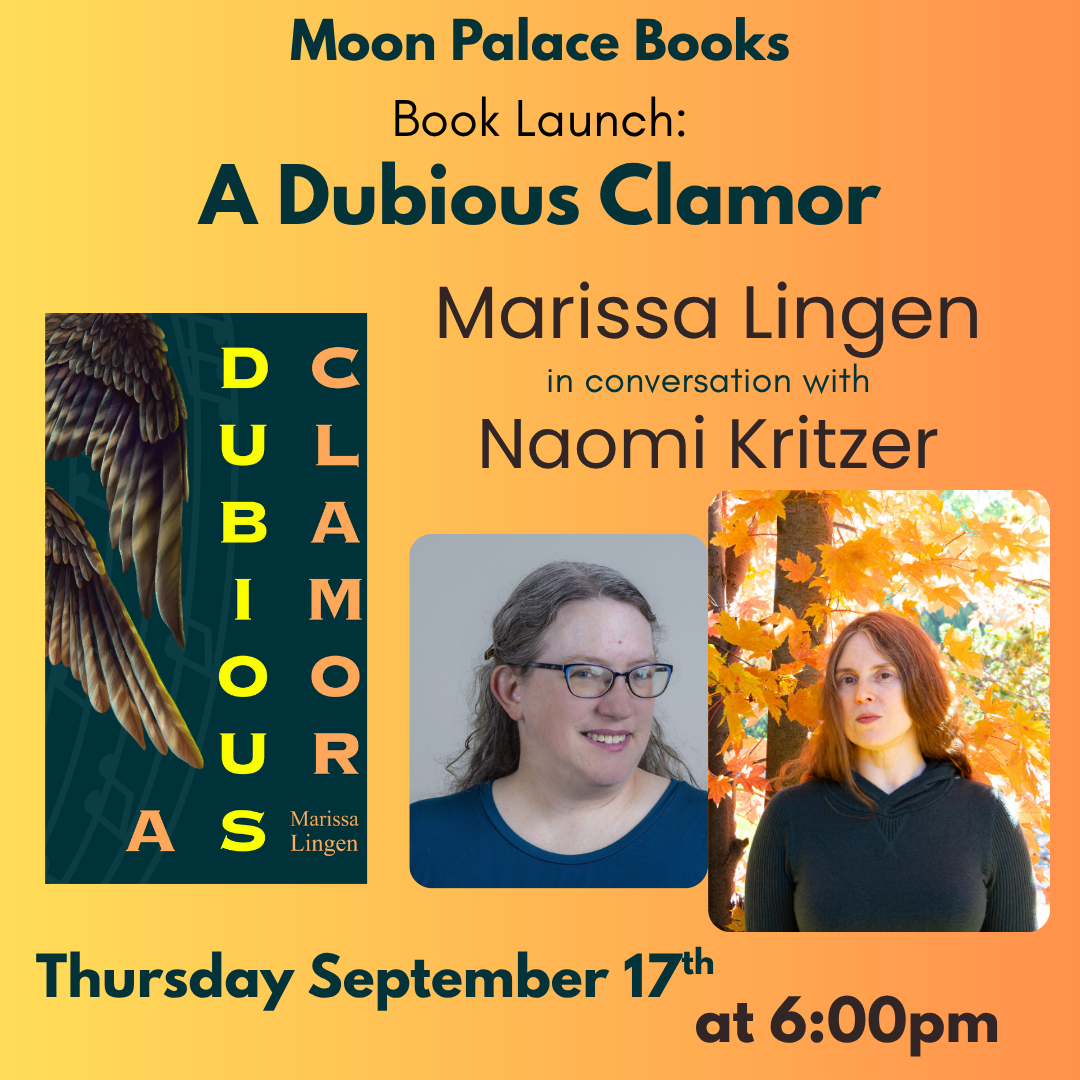
If you're going to be in the Twin Cities area Thursday, please do come to my book launch party, which is 6 p.m. at Moon Palace Books. There will be cake after (including gf and vegan options because that is how we roll), and I will have a lovely conversation with my friend Naomi Kritzer for everyone's enjoyment (plus audience Q&A and signing and, as I said, cake).

If you're not going to be in the Twin Cities, or if you prefer virtual events, or if you just can't get enough of me flapping my yap, there will be a virtual event on Wednesday, September 23 (not tomorrow, the Wednesday after that) at 6:00 Central. It will feature friend and fellow Horned Lark author Jo Miles, and we're hosted by our publisher, Kevin Hearne. Free to attend, reserve a spot here.

Still want to hear more from me about this book? Check out the Big Idea piece I wrote about it for John Scalzi's blog, or My Favorite Bit for Mary Robinette Kowal's! Or here's an interview with blogger Rob McLennan!

mrissa: (Default)
 

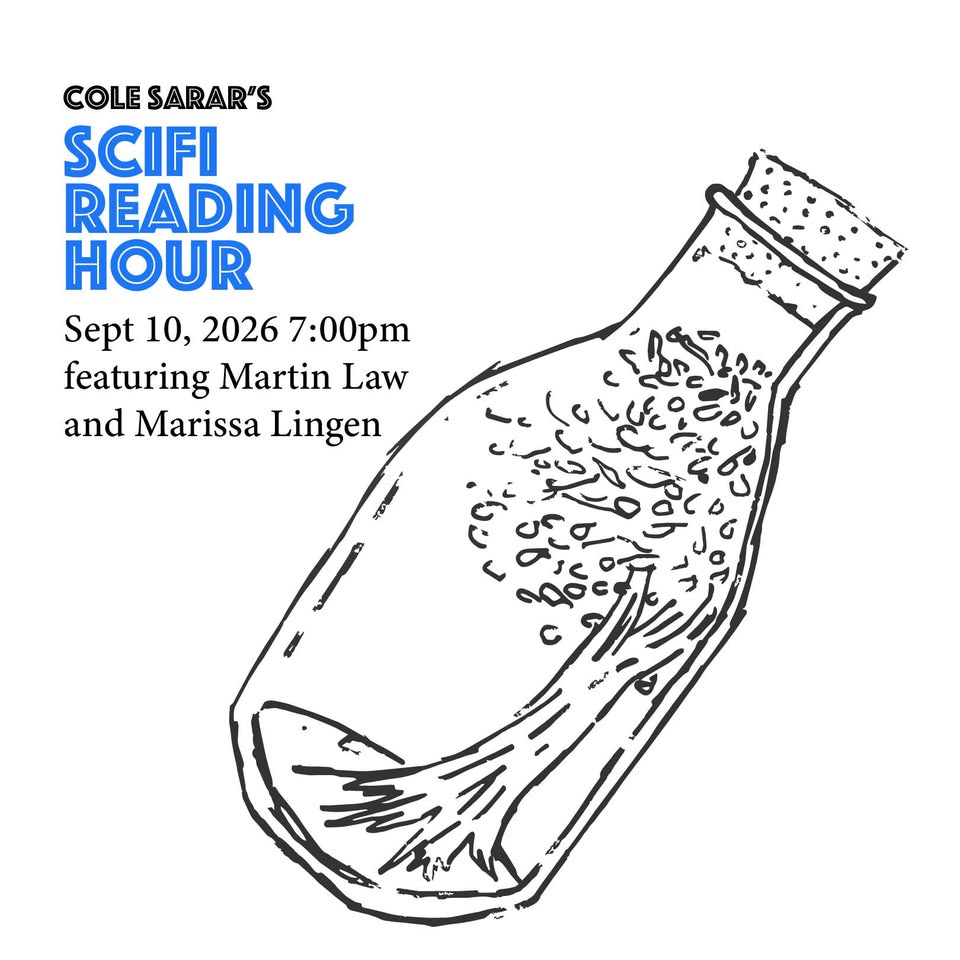
There's a lot going on this month, and here's tomorrow night's plan: Cole Sarar's SciFi Reading Hour at the Bryant Lake Bowl in Minneapolis!

That's right, 7:00 tomorrow, cool SF stories by me and Cole Sarar, read with specially composed musical accompaniment by Martin Law! Come on out to the Bryant Lake Bowl if you're local, it's going to be a good time!

mrissa: (Default)
 

I've already told you about my upcoming novella, A Dubious Clamor, coming September 15 from Horned Lark Press. But now, please come to a party about it!

That's right, Thursday, September 17--two weeks from when I am posting this!--at 6:00 p.m. at Moon Palace Books, 3032 Minnehaha Ave., Minneapolis, Naomi Kritzer will join me for a book launch event. I hope you join me too! Free event with free cake! Not free books, you'll have to buy one if you want one, but still, free event with free cake sounds pretty good.

If you're not going to be in Minneapolis and are sad about missing it, don't worry, the information for a virtual event will be coming soon. But in the meantime, Thursday the 17! 6:00! Book and cake!

mrissa: (Default)
 

Jorge Aguirre and Andrés Vera Martínez, Monster Locker: Nine-Tail Trouble. Another graphic novel with middle-school monster fighters and friendship/social dynamics, this time with a kitsune (it's in the title, it's not a spoiler) and a different character embracing their heritage. Very fast good fun.

Albrecht Berger, The Statues of Constantinople. Kindle. Short monograph about exactly what the title says. It was available in a give-away some time ago, and I picked it up on a whim; if you're not interested in the topic it's probably not worth seeking out, but it was interesting to put into the mental mix about worldbuilding.

María Luisa Bombal, New Islands. I don't know if it was the translation style or if this was in the original, but these short stories had a very early-20th feel to me, a bit of Henry James, a bit of Amy Lowell. They were written much later than that, so I'm still mulling over why that would be. They were vividly dramatic if that's the mood you're in.

M.A. Carrick, The Eye of Leviathan. Carrick is two friends of mine, and they have not lost their touch: their prose is still immediately and vividly engaging and propelled me all the way through this one. The setting is not ever going to be my favorite of theirs, I think--the Spanish "Golden Age" puts me in very much of a mind to pick at setting choices when there's an entire faerie realm that is verified and matters quite a lot to world developments, so I never settled into it as much as I wanted to, but I can't think anything the authors could have done to change that once they had that setting and were not really focused on the groups that actually were oppressed by the Spanish Empire of the time. I'll still read the next one for sure.

Rae Carson, Monster Monarch Maiden. This is what I mean when I talk about liking "stitial" fantasy as well as interstitial fantasy: it is absolutely genre-center, it is not the least bit interstitial, and it is really well done right smack in the middle of this genre I like. I also particularly thought the ending was well done, the denouement landed for me. Individual magical gifts and travels through highly varied landscapes and perils! Yes here I am.

Agatha Christie, Curtain, Dead Man's Folly, Dumb Witness, and One, Two, Buckle My Shoe. Kindle. The reading project continues. I have now encountered my favorite character in all of Christie so far, Bob the dog in Dumb Witness, who is far more patient with Hastings than Hastings really deserves.

Thomas Hylland Eriksen, Sanna Valkonen, and Jarno Valkonen, eds., Knowing from the Indigenous North: Sámi Approaches to History, Politics, and Belonging. Interesting collection of essays situating a northernness that is very distinct from westernness in cool ways, very glad I found it (used! for about 5% of what it would cost me to order it!) in this summer when I was taking Sámi cultural classes.

T. Kingfisher, Daggerbound. Second in its series, and I think it would stand alone reasonably well. Good times with people who live in swords! Or mostly bad times for them. Good times for me though. A human likes a gnole so much. The gnoles just continue great. And there is a giant bug--okay, if you're going to drop the book and freakout about a giant bug character, yeah, there sure is one, fundamental to the plot, too, but otherwise go have fun with this, it's one of her better ones.

Yoon Ha Lee, Fox Snare. Kindle. Caught up on the end of this MG science fantasy series and had a lot of fun with it, but for heaven's sake don't start here.

Scott Lynch, Locke Lamora: The Bottled Serpent and The Wizard Who Kept Himself Suspicious. Kindle. Two shorts, both entertaining. "Kaiju Agonistes" sets a high bar for "Scott Lynch's best short work," but I did have fun with these all the same.

Hilary McKay, Saffy's Angel, Indigo's Star, Permanent Rose, Caddy Ever After, and Forever Rose. Rereads. The only reason I didn't reread Caddy's World as well is that I don't own it yet and the library has culled their copy. I love these books so much, and once I started reading one I just wanted to be reading them all the time. They're like a crash course in subtext for the grade school set, an absolute masterpiece of perspective and of understanding different perspectives. I love them so much.

Emmet A. O'Brien, Here Be Dragons. Discussed elsewhere.

Aleksander Pluskowski, The Black Cross: A History of the Baltic Crusades. I'm not sure why other people are willing to tell me more about the Baltic Crusades this year than in previous years, but I'm here for it, tell me more about what weird stuff people were up to around the Baltic, that is my jam. This one is substantially focused south of my main interest (Finland and Sápmi), but I'm still happy to learn interesting things about Poland, Lithuania, Estonia, and all the smaller groups that went into them in various ways.

Alex Ross, The Rest Is Noise: Listening to the Twentieth Century. This is a history of Classical music in the 20th. Did you know that the only woman who really mattered in 20th century Classical was Jiang Qing (Mme. Mao)? Yeah, it's that kind of history. There were lots of other pieces of analysis that did not strike me as correct or well-grounded (you cannot! understand Sibelius! without understanding 20th century Finland at least a little! sir! sir!), and I frankly don't recommend this; there were some interesting spots but a lot of ugh.

Neil Williamson and Andrew J. Wilson, eds., Nova Scotia 2: New Speculative Fiction from Scotland. This is a very well-constructed anthology. I kept enjoying stories and thinking, "I wonder if this is the one that's why I knew I wanted this!" until I got to the one that is definitely why I knew I wanted this (it's the one about Lise Meitner, you'll know it a mile off), but the fact that there was any question is a very good sign.

Andrea Wulf, The Traveler: One Man's Quest for Humanity from the South Seas to Revolutionary Paris. Andrea Wulf is very good at her job, so this is entirely readable. If you don't have more than one Andrea Wulf book in you, don't go with this one, it is a side quest. George Forster is moderately interesting and is a great example of how "a man of his time" can mean things much more progressive than we're encouraged to think it can, but at the end of the day he is a footnote in the history of natural science, and even Wulf knows it. I like reading the footnotes. You may also like reading the footnotes. But that's very much what this is.

mrissa: (Default)
 

Once again, this is a work by a close friend, who provided me with the review copy.

I like middle books best, and one of the things I like best in middle books is ramifications. You've had the chance to set up both world and characters, you have some idea what parameters the particular series is working under: how does Corin Oshima react to aliens? What is her idea of honor? What kind of goals does she find satisfying? We know all that now, we've had it established, so now's the time to double down on matter anomalies, first contacts, and oh yes, solving a murder.

The Ralkhuri are here, Corin still has a fraught but duty-laden working relationship with the person who betrayed her most deeply before the series ever started, and we're definitely poking into the deeper layers of meaning of life, the universe, and everything. And this time the answer is much more complicated than 42. Don't start here, start with the first book, it's very much in print--but definitely keep going, there's a lot here to love.

mrissa: (Default)
 

This September is absolutely jam-packed with premium Marissa content, friends. If you're local to the Twin Cities area, come on out on September 10 for the SciFi Reading Hour at the Bryant Lake Bowl! The BLB is a Twin Cities institution, with restaurant, bowling alley, and theater area, and I'll be performing with musician Martin Law and sharing the bill with organizer and fellow SFF writer Cole Sarar. Tickets are $15 in advance, $18 at the door! And this is just the beginning....

mrissa: (Default)
 I'm happy to say that one of last year's stories, "And Every Galatea Shaped Anew," will be appearing in Neil Clarke's Best Science Fiction of the Year 2025. You can see the full table of contents and how to preorder here!
mrissa: (Default)
 

Natalie Adler, Waiting on a Friend. You find this out in chapter one, it is not a spoiler: this is the story of a young lesbian in NYC in the 1980s who can see ghosts, who can see all her friends who have died of AIDS except for her best friend. When I told the young people in my life this premise they literally gasped, and they were correct to do so. It's beautifully done, but if you think "that sounds like it would rip my heart out and repeatedly smash it with a hammer," well, yes, you're not wrong about that. I was up for that, and I recommend it, but no shade if you need to wait for a better day for it.

Danielle Allen, Radical Duke: How One Aristocrat--and the American Revolution--Transformed Britain. Not a particularly well-written book, but with material I wanted to know, which is in some ways the worst kind of nonfiction. Still, if you want to know about the radical politics of the Duke of Richmond and his political relationship with Thomas Paine, here's where you can find that.

Robert Jackson Bennett, A Trade of Blood. The most recent of the Ana and Din books. I think my favorite of them so far. I like where this went and where it seems to be going. Hooray.

Agatha Christie, Five Little Pigs, Lord Edgware Dies, Sad Cypress, Sparkling Cyanide, The Hollow, The Labors of Hercules, and The Sittaford Mystery. Kindle. Look what the library's digital collection got in from my holds list in time for me to travel. Yep, these sure are by Agatha Christie. The Labors of Hercules is a short story collection, and I continue to find mystery shorts unsatisfying; ah well.

Madelaine Drohan, He Did Not Conquer: Ben Franklin's Failure to Annex Canada. Too much boyfriend, not enough roller derby. Ope, sorry, that is: too much Ben Franklin, not enough Canada. You can read about Ben Franklin all sorts of other places and not nearly enough about the inter-British-colony politics of the 1770s. Ah well, it's a start at least.

Safia Elhillo, The January Children. For me this is an example of it being a good idea to read poets who don't immediately resonate, who are coming from a different place than oneself completely. Interesting poems rather than ones that speak directly to my heart, but that's good, I shouldn't be the target audience for everything, and I'm not.

Barbara Hambly, Death in the Palace. Latest in her 1920s Hollywood series. If you like these, this sure is another one, and I do, so here we are.

Heide Island, Romp! A Journey Through the Natural History of Otters and Why They Matter. Delightful natural history of otters, with lots of detail about field study of them. This kind of natural history is good for my spirits, might be good for yours too.

Michael Karns, Dennis Becker, and Lisa Golden Schroeder, Untamed Mushrooms: From Field to Table (A Midwestern Guide). Things you can do with foraged mushrooms. I like foraged mushrooms. I'd thought of several of these things more or less, but not all.

T. Kingfisher, Nine Goblins and The Raven and the Reindeer. Both very short older works, very different tonally. The latter is a Snow Queen retelling, which I often like and did like in this case; the former is goblin-perspective, which I often don't like but did this time. Like Ursula (that is, Kingfisher), I read and watched a great deal of All Creatures Great and Small as a tiny kid, so the fantasy vet helping the unicorn give birth and so on was exactly up my alley.

Just Knut Qvigstad and Isak Saba, Sámi Folktales from the Near and Far Worlds. An old compendium of folk tales, most of them with magical content, in a new translation. Beautiful, easy to read, fascinating perspective, especially because these are not retellings that are polished to fit particular molds or have palatable contemporary morals. Really good resource.

David Woodman, The First King of England: Aethelstan and the Birth of a Kingdom. When you read a lot of books about a particular topic, you start to pick out which one is for which strengths, and the major strength of this one over other books about Aethelstan is that it spends time on the Welsh and how they fit into the whole picture.

mrissa: (Default)

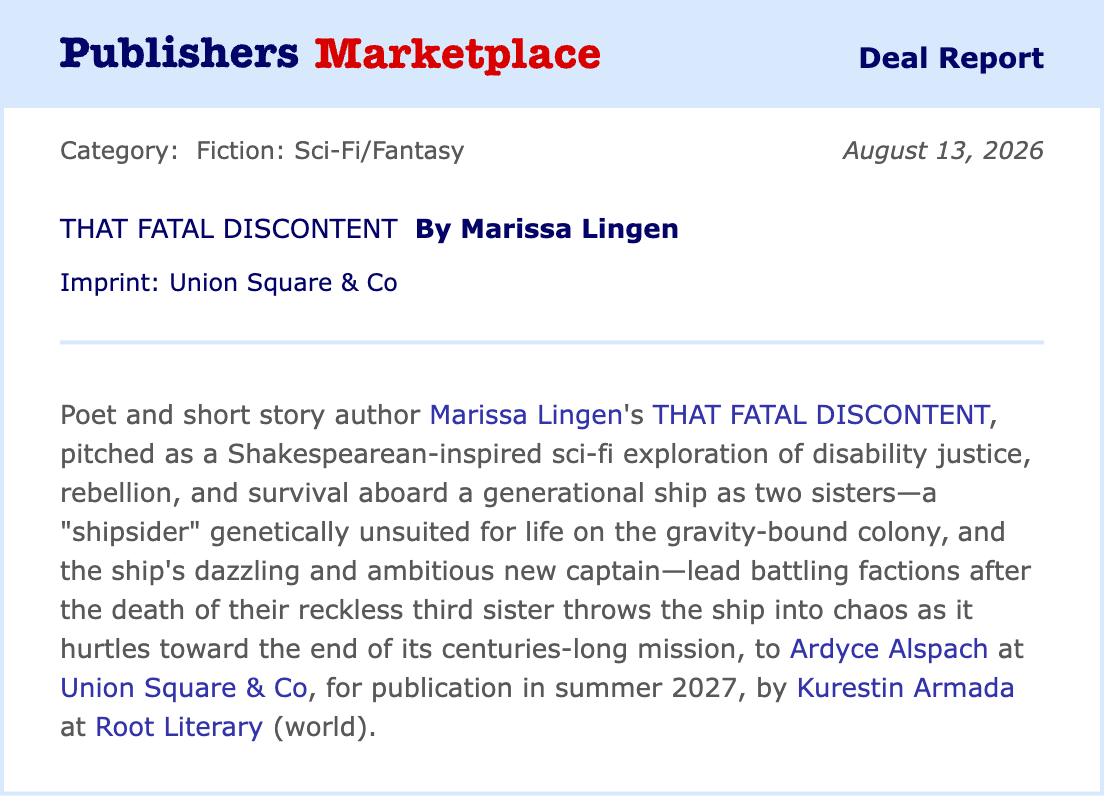
I'm in Michigan visiting M's family when what should show up in my inbox? OH HI:

What's this? Why it's the Publishers Marketplace announcement of next year's book! I'm doing edits on That Fatal Discontent now, to bring it to the world next summer! Something else to look forward to!


Since I'm traveling, I'm in an unfamiliar format that is not making it clear whether there's alt-text, so in case you can't read the image, it's all text, and it says, "PUBLISHERS MARKETPLACE Deal Report. Category: Sci-Fi and Fantasy. August 13, 2026. THAT FATAL DISCONTENT by Marissa Lingen. Imprint: Union Square & Co. Poet and short story author Marissa Lingen's THAT FATAL DISCONTENT, pitched as a Shakespearean-inspired sci-fi exploration of disability justice, rebellion, and survival aboard a generation ship as two sisters--a 'shipsider' genetically unsuited for life on the gravity-bound colony, and the ship's dazzling and ambitious new captain--lead battling factions after the death of their reckless third sister throws the ship into chaos as it hurtles toward the end of its centuries-long mission, to Ardyce Alspach at Union Square & Co, for publication in summer 2027, by Kurestin Armada at Root Literary (world)."
mrissa: (Default)
 

New story out in Strange Horizons today! Scarcely Gone is a thing I haven't done much of: it's a ghost story. In this case it's a ghost story with a John Denver title: "he'd rather play his banjo in the morning when the moon is scarcely gone" from "I Guess He'd Rather Be in Colorado." That makes this one of a random series of stories I've written from fragments of my dad's music, which are not linked in any other way except that their titles came from singing artists Dad loved around the house.

(This is why, incidentally, "the story behind the story" is often so hard to write: because "how did you come to write this story?" often has a beginning like "well, when I was preverbal my parents listened to a bunch of James Taylor, so....")

Anyway, hope you enjoy my foray into the world of ghost stories!

mrissa: (Default)
 New essay out today in Uncanny! Middle-Aged Love: Rereading in Your Forties and Beyond. I think we need to have a lot more conversation about the evolution of readerly identity with time, life changes, phase of life, and this is my upbeat start on that. No suck fairies here! Hope you enjoy!
mrissa: (Default)
 Melissa Albert, The Children. I found this very readable at the sentence, paragraph, and chapter level. When I put it down, I very much wanted to go pick it up again; it was the sort of book I wanted to be reading. Part of this is that Albert is good at the mechanics of writing, and part of it is "something mysterious and probably magical [but not necessarily] is going on with the family of a children's book writer" is really my jam. As I got further into the book and the protagonist processed more about her childhood, I started thinking that what I would say about this is that it's an interesting example of a book that works despite the protagonist being very reactive and having almost no agency for most of the book, at times seeming to flee from agency. Then I got to the ending, and that's not what I'm saying here after all, because I don't think it works after all, and I think the protagonist's avoidance is a large part of why, all the way through to the end. I didn't even feel like her agency had been taken, so I couldn't make it work in that direction, just: welp. No thank you. Sigh.

Agatha Christie, Mrs. McGinty's Dead. Kindle. On the quirky end of Christie's mysteries, which for me is nice.

Jennifer Graham, The Fall of Iris Henley. A teen thriller about a girl who's anonymously accused of murder and finds very little support from the people she once trusted. A very tense read, unfortunately all too real in its social dynamics.

Christopher Gravett, Towton 1461: England's Bloodiest Battle. A friend picked this up, I don't know whether it was at Towton or somewhere related, but this is definitely the kind of lots-of-pictures battlefield history they sell at battlefields and related museums. Lots of detailed maps from different points in the day. Useful if you're interested in this specific topic, which I am, it's adjacent to my Ricardian needs.

Scott S. Greenberger, The Unexpected President: The Life and Times of Chester A. Arthur. I would love to say that Chester A. Arthur was more interesting than you'd think, but truly, he's not. Now we know, I guess. I don't even blame Greenberger. Just: yah, nobody wanted this guy to be president including himself, and he was, and then he died.

Inhabit Education Books, The Life & Art of Germaine Arnattaujuq. This title came up when I was searching (fruitlessly) for some other Arctic art topic in my library's card catalog. It is very much a children's book, the sort of simple summary of a complex career that I didn't really like even when I was its target age. But the bits of her work visible in it were cool.

Kim Choyeop, If We Cannot Go at the Speed of Light. I feel like we're getting a wider range of East Asian SFF translated into English than we were a decade ago, and I feel like particularly Korean SFF is now allowed to be human-focused and "soft" in ways that 1) I love and 2) were not considered translation-worthy in the not-too-distant past. So when there's a very human-focused short story collection like this one, I feel very lucky indeed. Recommended.

E.C.R. Lorac, Crock o'Lune. Kindle. A not particularly quirky regional mystery, reasonably well done as the other Loracs generally have been.

Sarah M.S. Pearsall, Freedom Round the Globe: A World History of the American Revolution. Lots of books about the American Revolution this year for obvious reasons, and I appreciate that this one treated both the lead-up and the fallout as parts of global phenomena contributed to by many people and many types of people. Interesting stuff, in some ways wish it had been longer (but it's not a super-short book already!).

Andrew Pettegree and Arthur der Weduwen, The Bookshop of the World: Making and Trading Books in the Dutch Golden Age. So much about printing and selling books! So much! So much attention to printing ephemera! This is for the dedicated nerd, but if you are one, here it is.

Maya C. Popa, Wound Is the Origin of Wonder. The kind of poetry collection that takes language musings and runs with them at poetic length, which is nearly always of interest to me. The titular poem and related ones thread through in a very good way.

Mykaela Saunders, ed., This All Come Back Now: An Anthology of First Nations Speculative Fiction. This is a book club book, and the "First Nations" in the title refers to Australian First Nations only. I can't say it's one of our more successful selections, I think partly because it has several excerpts and we, on average as a group, really don't like excerpts. (I personally do not like excerpts! I am part of bringing the average well into the negative on this point!) I think the other thing that was difficult about this anthology is that none of us had the experience to be able to sort out editorial bias from general cultural viewpoint. So...now we'll all have this when we read more Australian First Nations SFF, and that's a good thing? But it didn't make the experience of reading and discussing this volume as satisfying as some others.

Nghi Vo, The Scarlet Ball. Discussed elsewhere.

Jesse Wegman, The Lost Founder: James Wilson and the Forgotten Fight for a People's Constitution. Wilson was an absolute personal disaster, and Wegman never gets so entranced with his subject that he loses sight of that. (To be fair, Wilson would make it very hard to lose sight of that.) He pointed out a lot of the things many of us see as problems now in the US Constitution! He fought for it to be better than it eventually was! Also he had absolutely no financial skills and considered running and hiding to be a great approach to problems, so. Yeah.

G. Willow Wilson and M.K. Perker, The Stoneshore Register. This is the sort of graphic novel that I can see would better suit people who are far more visual than I am. Its art is lovely, its text goes beautifully with the art, and there just isn't enough story there for me to find it particularly satisfying.

John Wiswell, The Dragon Has Some Complaints. I really really hope this book finds its audience, because it's warm and funny and also extremely honest about physical and emotional trauma recovery, and frankly when I've had physical and emotional trauma recovery, things that were both honest and funny were extremely hard to come by. Especially things with dragons! Especially things with dragons and political machinations! I love those things! I love this book! Read this book.

Francis Young, Silence of the Gods: The Untold History of Europe's Last Pagan Peoples. I really like that this book is primarily organized temporally but also has geographic sub-organization after that, because it reflects how much Young is not assuming that the beliefs of, say, the Saami and the Estonians had to be at all similar to be dealt with in a similar analysis and time frame. He's very careful about the places where he can talk about the people but not about the details of their beliefs, and that's fascinating too. I'm very interested in this topic, but I think that even people who are less keen on it might find a lot that would be of interest here.

mrissa: (Default)
 

Review copy provided by the publisher.

I knew this was not my sort of thing, and I was correct, but Nghi Vo writes so well that I thought it was worth giving this specific instance of not-my-sort-of-thing a try, and that was also correct. This is in some ways like a billionaire romance if the author was really honest about the morality of billionaires. And also if the billionaires were literally natural disasters taken on (occasional, voluntary) human form.

So yeah, not a lot like most billionaire romances...but it does have the attention to luxury detail, tuned to a dark fantasy precision. Give our heroine a makeover? why not lend her entirely new faces? What happened to the previous owners of those faces? Don't ask that, smile, look how beautiful you are as someone else! So beautiful you could charm a hurricane. Literally. There are dances galore leading up to the titular ball, there is backstabbing and politicking and exquisite clothing, and there are forest fires masquerading as people for fun and profit. And getting boatloads of both.

If you're hoping for a moral ending where the wicked suffer and the good are rewarded, this is not that book. If you can be satisfied with something a bit more visceral, well...this might be the thing for you. Especially if you like either the trope of "dangerous rich man, I can change him" or that trope's subversion.

October 2026

S M T W T F S
     123
4 567 8910
11121314151617
18192021222324
25262728293031

Syndicate

RSS Atom

Most Popular Tags

Style Credit

Expand Cut Tags

No cut tags
Page generated Oct. 16th, 2026 10:50 pm
Powered by Dreamwidth Studios